Subscribers Are History, Views Are Demand: How to Read a Niche Correctly
Most niche research goes wrong at the very first glance, and it goes wrong quietly. Someone opens a channel, sees a large subscriber number under the name, and decides the topic is alive. Nothing else in the process recovers from that moment, because every later step is built on a number that was never answering the question.
After enough years of doing this work, the habit I would most like to hand to a new creator is not a tool or a spreadsheet. It is a reflex: before you read a number, ask what period of time it describes.
The number people open with, and what it actually records
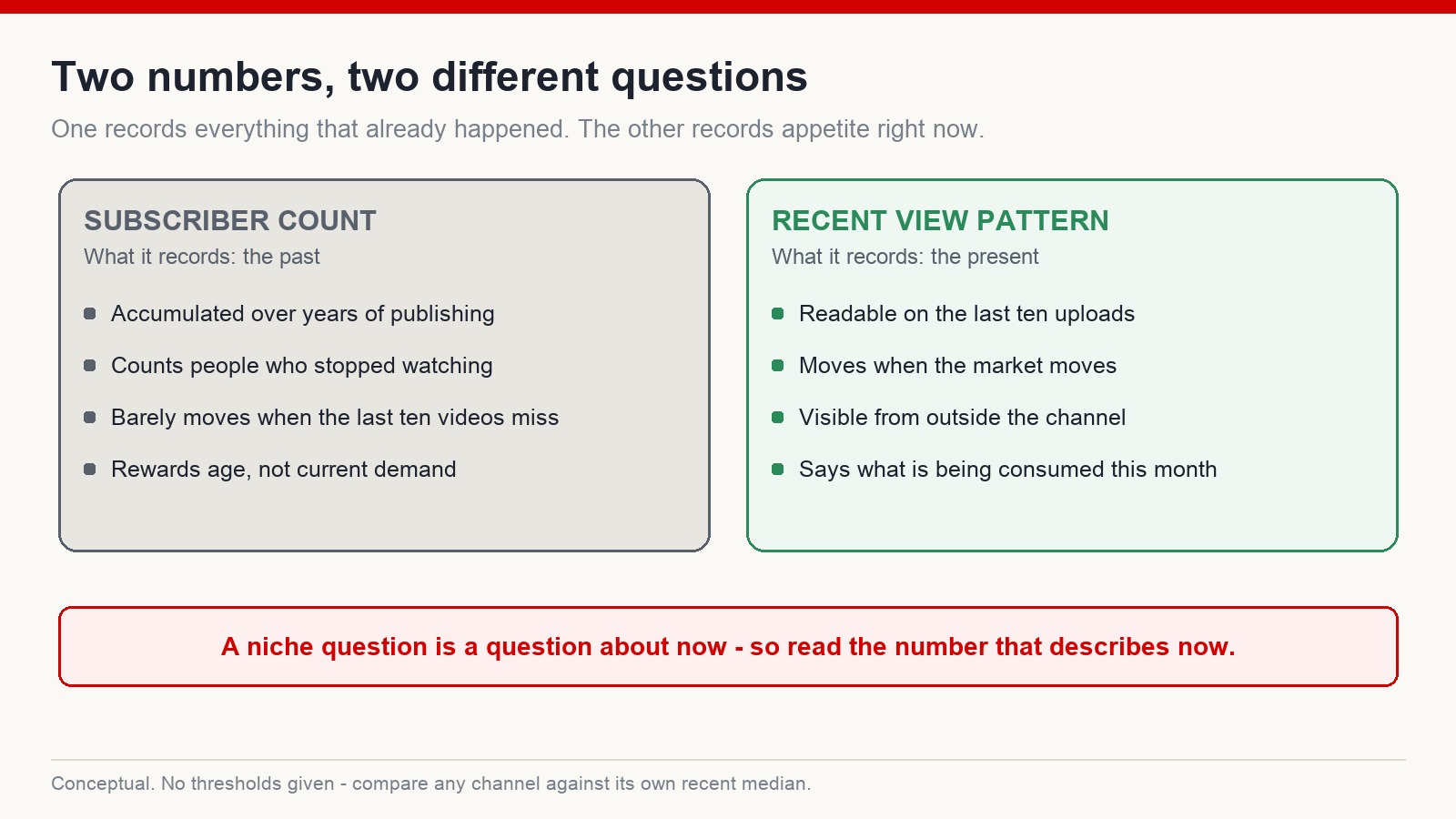
A subscriber count is a cumulative total. It is the sum of every decision anyone ever made to click subscribe, going back to the channel’s first upload, minus the small fraction who bothered to undo it. It never resets. It does not shrink when the audience drifts away, because most people who stop watching a channel never unsubscribe from it – they just stop showing up.
So a large subscriber count tells you that a channel was interesting to a lot of people at some point across several years. That is a real fact. It is simply not the fact you need when you are deciding whether to build something in that space this month.
The number that describes now
The recent view pattern – what the last ten or so uploads did relative to each other and relative to the channel’s own history – is the closest thing an outsider gets to a live reading of appetite.
It has three properties that make it useful. It is current, because it is generated by videos published in the last few weeks. It is responsive, because it moves the moment the audience loses interest, whereas the subscriber total sits still. And it is visible from the outside, which matters when you are researching channels you have no access to.
You do not need a threshold for this, and I would be suspicious of anyone handing you one. The useful comparison is internal: how do this channel’s last ten videos sit against its own median from six months ago? A channel whose recent uploads are landing well below its own past is telling you something about the room it is in, no matter how impressive the number under its name.
Three readings that look like evidence and are not
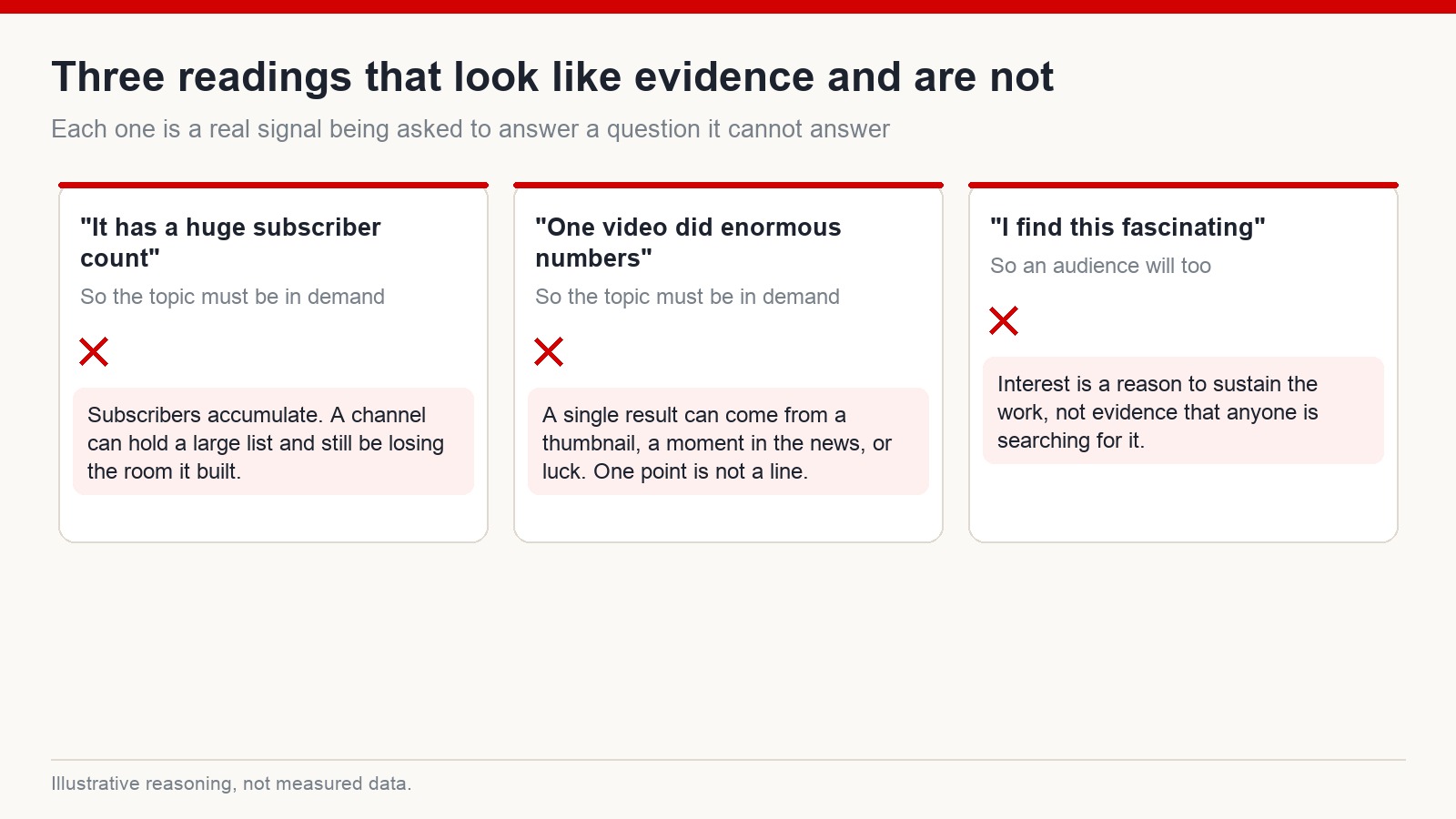
Three specific misreadings account for most of the bad niche decisions I have watched people make, including my own.
The channel is big, so the topic is in demand
Size can be inherited. A channel built over eight years carries trust the recommendation system now hands it by default, and that trust keeps producing views for a while after the underlying interest has thinned. Big is a statement about the channel, not about the room.
One video did enormous numbers, so the topic is in demand
A single outsized result can come from a thumbnail that happened to work, a coincidence with something in the news, or plain distribution luck. One point does not make a line. What you want is the same theme performing across several videos and, ideally, across several channels – the majority principle, applied to evidence rather than to your upload schedule.
I find it fascinating, so an audience will
This one is the hardest to give up, because it feels like the honest, non-cynical way to choose. Your interest matters enormously – it is what will get you through episode forty when nothing has broken through yet. But it is a reason to sustain the work, not evidence that anyone is searching for it. Those two things get confused constantly, and the confusion costs people a year.
The check that settles it
Once you think a sub-niche has real appetite behind it, there is one more reading worth doing, and it is the one people skip: find a small channel serving the same sub-niche and see how it is doing.
This is the entry-door test. If only established channels are winning in a space, the demand you are seeing may be attached to those specific brands rather than to the topic. If a channel with a modest subscriber base and a short catalogue is also pulling views well above its own size, the appetite is in the topic itself – and a new entrant with no history is not automatically locked out.
Both readings are useful. The first tells you the market exists. The second tells you whether the door is open.
What people get wrong immediately afterwards
Finding a sub-niche with real demand is oddly dangerous, because the relief makes people generous with themselves. They publish four videos on the thing that works, then start wandering into adjacent territory because it seems obvious that the audience will follow.
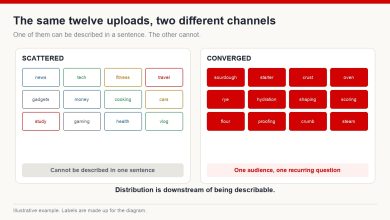
They often do not. The classification you spent weeks earning is built from the bulk of what you publish, and it dissolves at roughly the speed you dilute it. My own working habit is to keep the clear majority of uploads inside the sub-niche and let a small minority test the edges – roughly four in the niche to one outside it, loosened a little once a channel has enough history to absorb a miss. That is a personal working ratio, not a rule the platform enforces.
A thirty-minute triage
Before you commit to a direction, three questions, answered from the outside with no special tools:
- Which channels are currently winning here, and are their recent uploads holding up against their own history?
- Across the twelve most-viewed videos of the strongest one, what theme repeats most often?
- Is anyone small and new also getting traction on that same theme?
If all three answers come back clearly, you have something worth a real week of research. If the third one comes back empty, you may be looking at a room where the demand belongs to the incumbents rather than to the subject.
Where this leaves you
None of this removes uncertainty. Platform behaviour changes, audiences move, and a well-researched niche can still refuse to work for reasons nobody can see from outside. What reading the right numbers does is remove the avoidable failures – the ones where the decision was wrong before the first video was ever scripted.
Read the past when you want to know what a channel has been. Read the present when you want to know what a market wants. If you want the process I use for building faceless channels aimed at English-speaking audiences, it is laid out in more detail at mmoyoutube.com.
Frequently asked questions
Does a low subscriber count mean a channel is not worth studying?
No – often the opposite. A small channel getting outsized views on a theme is one of the most informative things you can find, because it suggests the appetite belongs to the topic rather than to an established brand.
How many recent videos should I look at?
Enough to see a pattern rather than an event. Around ten recent uploads is usually enough to tell whether a channel is holding its level, and around twelve top performers is enough to see which theme repeats.
What if a niche looks strong but nobody small is succeeding in it?
Treat that as a caution rather than a verdict. It can mean the demand is attached to specific incumbents, or that the format is expensive enough to keep newcomers out. Either way, it is a harder room than the view counts alone suggest.
Should I ignore my own interests entirely?
No. Interest is what keeps you publishing long enough for anything to be measurable. The mistake is treating it as market evidence. Use demand to choose the room, and use interest to choose which room you can stand to live in.